October is Connected Educator month, and this post is a celebration of connecting with others through a collaboration, on the theme of Innovation. Most importantly, it serves to meet the #edblognz challenge to collaborate with another blogger (or in our case, bloggers) on an important issue in education.
We are a triad (to clarify, not the secret society kind) of educators, representing primary and secondary. Each of us are leaders of learning, regular bloggers, active in the ‘tweetmoshere, and passionate about future focussed learning.
We chose to blog about innovation, and to explore the notion ‘is innovation a future focussed teaching must have and if so, what does it look like, and how do you encourage all educators to embrace innovation?’ We wanted to reflect on what Grant Lichtman had to say in his keynote at Ulearn2015, and in particular, apply that to what we currently do, and how it might strengthen our own journeys with innovation. We make no promises to solve these questions!
Is Innovation a future focussed teaching must have?
St3ph007
Yes, and a strong YES.
Innovation, for me, sits at the heart of schooling improvement. The old adage of you will always get what you already have if you keep doing what you already do, has a strong ring of truth to it. It is not even about being ‘future focussed’ for tomorrow, but for now.
When I think of educational innovation, I see it as improving upon the existing (in same case removing or replacing), and the addition of new methodologies, ideas and concepts to move our thinking and processes forward . When I asked Technoman for his thoughts, he said that innovation is about ‘understanding the need, not the want and putting that into practice’, and I could see how that relates well to an educational context.
Within our system there are so many inequalities and these pose a significant challenge to being responsive teachers, leaders and indeed, to being a responsive system. Innovative thinking has to be a part of a future focussed educator's repertoire if we are to meet these challenging issues!
mikebuckham
Absolutely necessary. Without innovation, just as in life, we stagnate and perish.
Sam Gibson
Absolutely. Without innovation, we all become stagnant. Innovation is what makes the world go round in the 21st century. We often hear the phrase “We are training our students for jobs that do not exist yet”. Therefore, we need to ensure that innovation and problem solving are at the top of the list of skills that we are encouraging with our students. If I am asking my students to be innovative, it is also imperative that I am innovative as an educator.
What does it look like?
St3ph007
Obviously, innovation is going to look different for each individual, setting and context. At our place, innovation is on a continuum; some teachers are fully immersed, active and engaged, whilst others are a little more wary, simply content to let others bathe in the pool of innovation, whilst they quietly dip their toes with trepidation. Sometimes it is messy, sometimes it is challenging and sometimes it is magic!
In an effort to cater for this diverse ‘continuum’ of need, we set up our innovations team. I have blogged about fostering innovation previously, which you can read about here. In a nutshell, the innovations team was developed to provide a place for those early adopters to gather, share ideas, practice (including successes and areas of future development) and to support each other's inquiries. As an opt in option, it gives the passionate teachers a voice and safe place to ‘wonder’, without adding to the fear other teachers might hold around change and innovation.
mikebuckham
It looks like life. A complex and ever-evolving ecosystem that cannot exist in a vacuum - it is surrounded by, infused and interacting with other systems and processes that influence and affect it. Choices, opportunities and threats, failures and triumphs, weaknesses and strengths that constantly move and mould.
"Failure is success, if we learn from it." (Malcolm Forbes)
Sam Gibson
Innovation is all around us, and it always has been. However, today innovation is moving faster than ever. New ideas, new equipment, new paradigms. However it looks, the most important thing is that we keep moving forward with it. This is where we can get uncomfortable with change, but as Grant Licthman said: “Embrace the discomfort”. I love the Dewey quote: “If we teach today as we taught yesterday, we rob our children of tomorrow”. As the world keeps changing, this quote will forever be true.
How might we encourage others to embrace innovation?
St3ph007
This has to be the billion dollar question facing all early adopters and leaders with an affinity for innovative practice. Understanding change management, making sure we have a robust self review process, being open and transparent and continuing to foster trust are all key elements in helping others overcome their concerns and fears.
I posed the question the other day on Twitter during Grant’s keynote when he talked about fear holding teachers back, that perhaps if we understood what was at the heart of that fear, and we unlocked it, then we could move forward as a system. For me, this begins with understanding what is sitting at the heart of my own teams fears and concerns. If we understand what the problem is then we can work together to find the solutions (Grant elaborated on using Design Thinking during his workshop which will be a useful tool to assist this).
mikebuckham
I encourage others by being open to change, by considering and planning, by trying new things or ideas and reflecting on the process and the results. I am transparent. I share my ideas and my outcomes with others for critical reflection, feedback and feedforward. I keep going. Life's a journey. Learning is life itself and therefore is also a journey. You journey by moving forward, one foot in front of the other, by increments (some large, some small).
Sam Gibson
We all ask our students to adopt a growth mindset and learn from their mistakes. We, as educators, need to do the same. Teachers need to be encouraged to innovate. We need to have an environment where it is ok to fail, where we are co-learners in the classroom. Part of this journey should involve reflecting on, and sharing, experiences. Personally, I have found blogging about my experiences a hugely valuable process. This is where I really reflect on what I am doing. Through this, my PLN on Twitter has been valuable in terms of providing encouragement, feedback and new ideas.
How do we foster innovation?
How will we strengthen it?
Key takeout from Grant Lichtman's keynote and how it applies to our current journey?
st3ph007
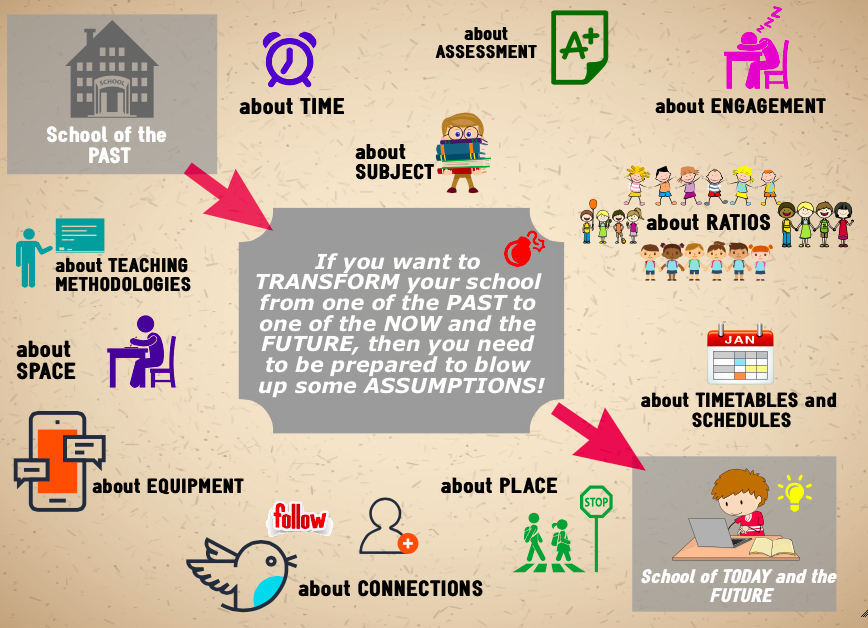
One of the key takeouts I have been absorbing from Grants keynote is that we need to have open and honest conversations with all members of our school community about what we do, why we do it and what we want it to be like. It starts by challenging the assumptions of the status quo (see infographic below). Talking about these things and the resulting changes that may come from it will be uncomfortable, and they will be challenging, but on the flip side, they will be exciting!
We can’t be limited by our notions of schooling based on what was done in the past, but rather, be prepared to be embracing of what the future is and can be. At our place we have started the conversations but we still have some distance to travel. Big things come from small steps, and I am more than confident that we are on our way!
Sam Gibson
As Grant Lichtman mentioned in his keynote, the world is changing at an incredible rate, we therefore need to reimagine the fundamental learning relationships between teachers, students at knowledge. To be truly innovative, schools really do need to blow up many assumptions that we have about learning. Most teachers are so used to being the main source of knowledge within the classroom. This idea has changed dramatically over the last ten years with the technological advances we have seen. When thinking about technology use in the classroom, I always like to ask teachers “What are the main ways in which technology is allowing you to enhance the learning for your students?”. This question should be in the forefront of every teacher's mind in today’s classrooms. This is where we can start to blow up some of the assumptions from the past, and look to new innovative ways that we can facilitate learning.
mikebuckham
Using the What/So What/Now What reflective model I have been using thus far in relation to Grant's Keynote:
What:
The one-word version: Dewey
So What:
Dewey's philosophy of teaching is (for me) essentially "Education is not preparation for life; education is life itself." It is, or should be, experiential. We learn by experiencing and exploring and trying, failing and trying again. It is not the simple transfer of knowledge from one receptacle (teacher's brain) to another (student's brain). Our industrial-age model is, and always has been, defunct, defective, and destructive to the learning process. So why continue with it? For me, the answer is, we don't!
Now What:
I will continue to disrupt, to set fire to the silos, through:
being open to new ideas and to change
growing my understanding of my own and others' pedagogical approaches, philosophies of learning, and the tools of my profession in a future-focussed learning world view
- collaboration and connection with my professional colleagues, both within and outside my kura, and with other agents of change, individuals or groups, for the benefit of the akonga in my care and my own professional and personal development and growth
* * *
In conclusion, although we are three educators from three diverse settings, we are not that dissimilar in our thinking. There is a reassurance here, in that if we can be on message over such an important issue in education then this must surely be a great sign. To be able to collaborate and share thinking across sectors has been a powerful reminder of what we can achieve as educators when we share ideas and work together. I believe it is exactly this that Grant was talking about when he said if you want to be relevant in the future than you need to be a 'big node' in the 'cognitosphere'.
Ngā mihi nui kia kōrua, Steph and Sam, for helping me to fan the 'bushfires of innovation!
Link to Steph's blog
Link to Sam's blog